
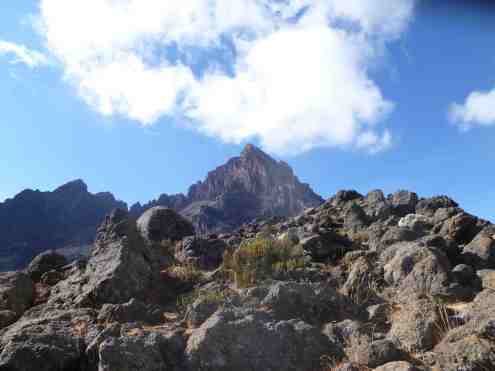
Pole pole. That’s the Kilimanjaro motto. It means “slowly slowly” in Swahili and is heard often on the mountain as it’s the only way people can get up to Uhuru Peak at 5,895 meters (19,341 feet). Well, pole pole and porters. The dormant volcano known as Kilimanjaro is made up of three mountains: Mawenzi, a craggy, rocky, jaggedy mountain that looks like a Disney villain’s awesome castle and requires technical climbing skills and equipment to summit (so not many people have); Kibo, the snow capped mountain that is what people are talking about when they say they summited Kili; and the forgotten Shira. Poor Shira.
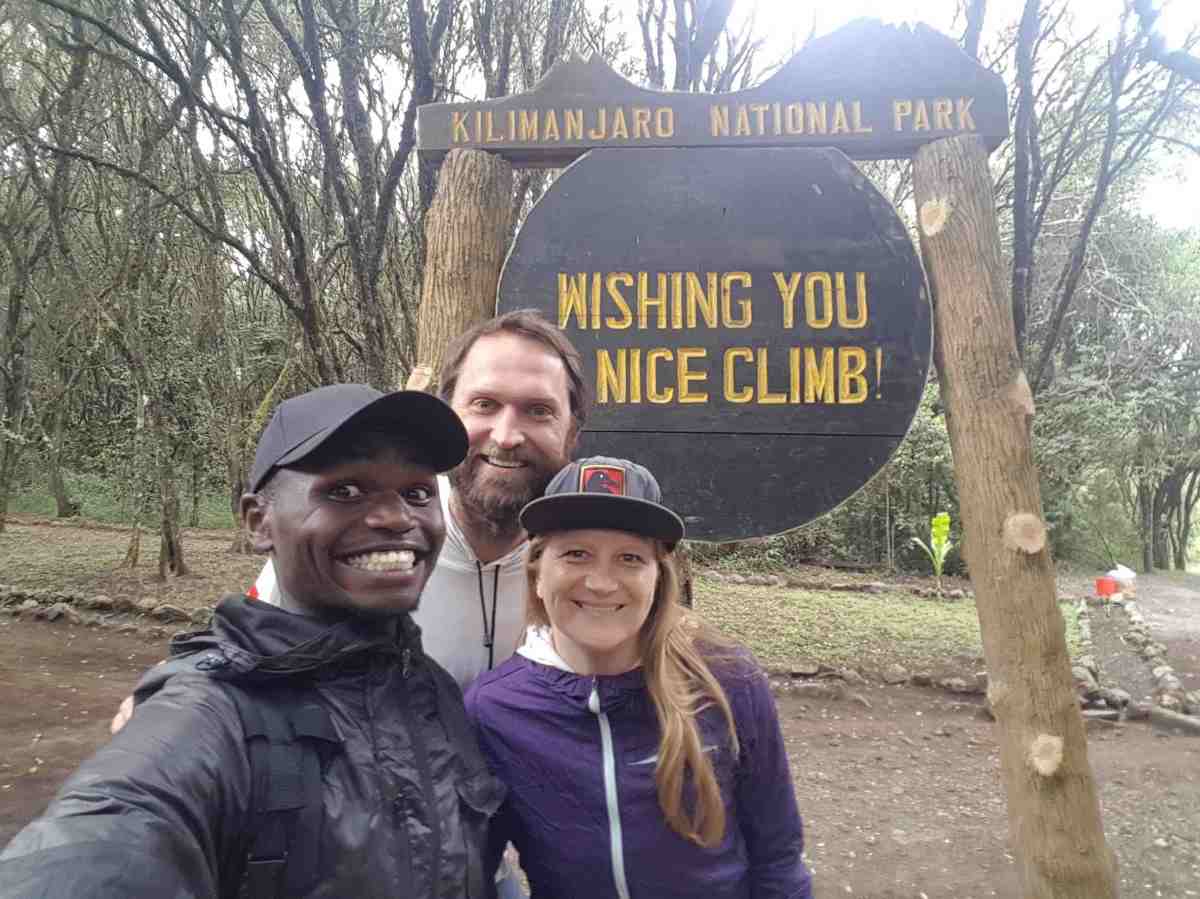
A week ago, Bill, his colleague Victor, and I boarded a bus in Nairobi to Arusha, Tanzania with our Kenyan guide Dennis. We had a 6 day trek ahead of us with our summit attempt on Friday morning (beginning Thursday night). After researching (ok fine, after Bill researched and shared the best links with me) about all the different routes, we (ok fine, I) decided on the Rongai route because despite being less popular and traffic-y, it apparently has a high success rate. My body doesn’t take to altitude well at all and this had a great 6 day option that included an acclimatization hike. We especially appreciated the fact that we would not be hiking with a hundred strangers, and in fact saw very few people on our hikes earlier in the week (other than porters passing us). Those early camps were small and cozy. Also, the Rongai route uses the Marangu route to descend, so we would get to see two routes, and both sides of the mountain, and I liked the thought of climbing up and over. So Rongai it was!
*Quick heads up that I will be writing about natural bodily occurrences so don’t be disgusted because it’s human. If you’ve never had anything exit your body through an orifice then you’re probably a Replicant. (Sidebar: do Replicants poop? Don’t make me watch Blade Runner again or google this right now, so if you know or have a theory, please let me know in the comments section!)*
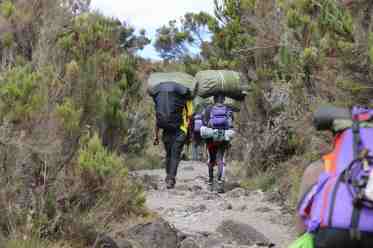
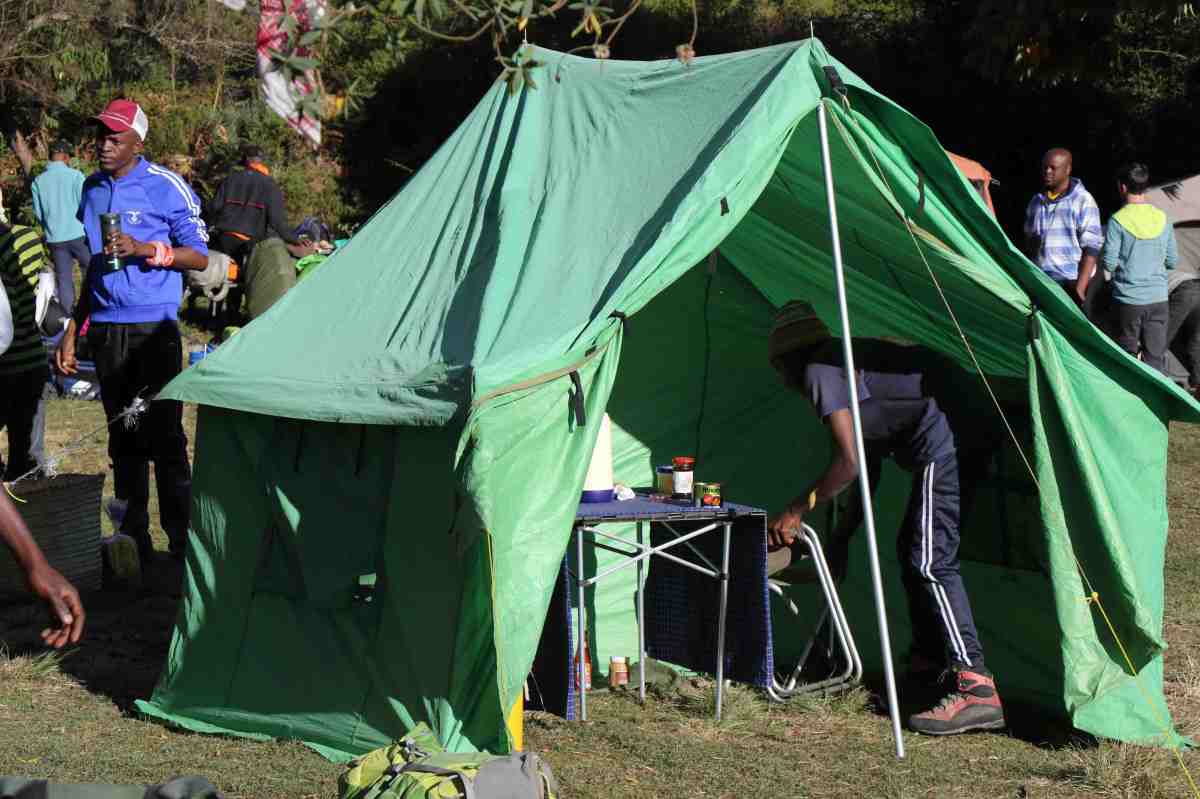
After a good morning poop, we leave our hot showers and WiFi behind at the hotel in Moshi and drive in a packed 15 passenger van to the Rongai gate. There were three of us trekkers, Dennis our Kenyan guide, two Tanzanian guides Johnson and Isaac, (per Tanzanian law if your group is two or more, two Tanzanian guides must accompany the trekkers (which makes sense because not everyone from a group may make it up to the peak so one guide continues ascending while the other descends)), one chef Adam who should probably open a restaurant, one waiter Emmanuel, and 8 porters. EIGHT. They carried all our stuff (heavy bags of clothes, sleeping bags, sleeping pads, and our REI Half Dome Tent) as well as their tents, their stuff, enough food for 3+ meals a day for 14 people for 6 days including plates and utensils and serving trays and bowls, a “mess hall” tent where we ate all our meals, and a big heavy gas canister for cooking. The law states that each porter cannot carry more then 20 kilograms (44 pounds), so that’s why we needed that army. They were incredible. They would leave after us from camp as they packed up and cleaned up, fly past us to the next camp, set everything up and have snacks ready for us when we got there. True athletes. Running uphill at altitude with a bag on their back and their head. There’s a new SallyFit exercise! (For the maybe 2 people reading this who know what that is.)


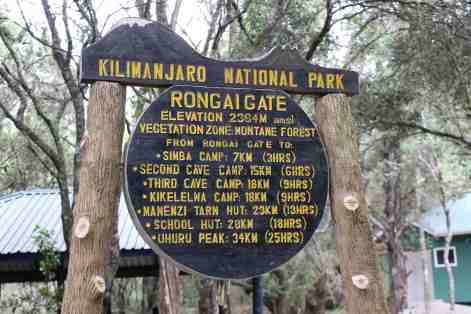
Day 1 at Rongai gate (elevation: 2,364 meters; 7,755 feet), we have lunch while the porters get their bags weighed, and then we’re off to Simba Camp (elevation: 2,671 meters; 8,763 feet), an easy 7 kilometer (4.3 mile) hike. The sign said it would take 3 hours but our excitement got us there in an hour and a half. When we got there we asked Dennis if this is where we were staying and laughed incredulously when he said yes until we realized he was serious. I thought to myself, “I’ll definitely make the summit if this is any indication of how well we hike.” Our porters had set up our mess tent and Adam had prepped our meal. We meet Emmanuel our waiter, who brought us consistently delicious food every meal and general cheer every day. I don’t know if I’ve mentioned ugali in any other blog post, but it’s an East African staple made of corn which I find disgusting unfortunately. I was so worried that it would turn up as dinner one or more nights, but Adam never made ugali for us, only the porters! Every dinner started with a hot soup, and it was always a delicious hot soup. Very flavorful veggie soups that were great for hydration and for warming us up as those nights get cold. I would hold the bowl in my hands to warm them and drink the soup. No spoon required. Then there was always a starch (rice or potatoes or pasta) and a vegetable mix and a meat. Breakfasts were eggs, pancakes, fresh fruit (I wonder who carried the watermelon), and porridge which is basically liquid ugali (read: I never ate it).
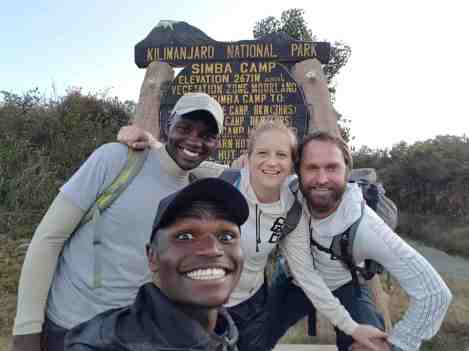
During dinner at Simba camp, we meet our guides Johnson and Issac again for a debrief. Johnson talks about the spiritual, mental, and physical aspects of hiking Kilimanjaro and then says “any questions?” I was like “yes, several!”  What time are we leaving here tomorrow? What time is breakfast? How many kilometers is our hike tomorrow? Approximately how many hours will it take? What is our next destination called again? What is the terrain of tomorrow’s hike? What is the general climate so we know what to wear? All my questions were answered and we were off to bed. Bill had the Kilimanjaro brand tea which was highly caffeinated and he didn’t wear enough layers so he did not sleep well. He couldn’t fall asleep, he was cold, and he got up three times in the middle of the night to pee. Poor guy. (The rest of the nights he slept great, so fret not readers!) I instead slept so well. I wore too many layers and actually got hot! My Hyke and Byke brand sleeping bag goes below freezing and I didn’t drink enough water during the day so I didn’t have to pee during the night. I thought to myself, “I’ll definitely make the summit if this is how well I am feeling.”
TO BE CONTINUED…


 Krisztina Finn
Looking forward to days 2 and 3. I would never do such a hike for the life of me. If anything, I would do no more than a one day or half day hike that does not involve things like navigating my way through water and rocks.
LikeLike
It is good to be prepared, at least by asking many questions…
LikeLike