
“Do you see the leopard?”, Harrison asked as we drove along the bumpy park road. We were on our full day safari at Maasai Mara, Kenya’s most renowned game reserve that is adjacent to the Serengeti in Tanzania. We had been driving for a few hours in search of the elusive leopard without any luck. Going on a safari is kind of like fishing. There are long periods of silence, contemplation, enjoying the scenery; and then a rush of adrenaline when you get a nibble on the line or you spot an exotic animal. We just got our nibble.
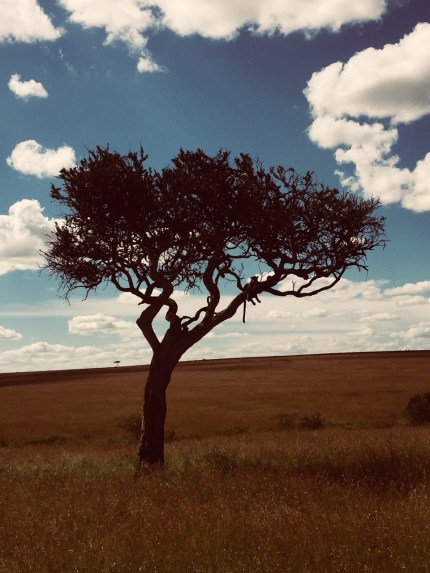
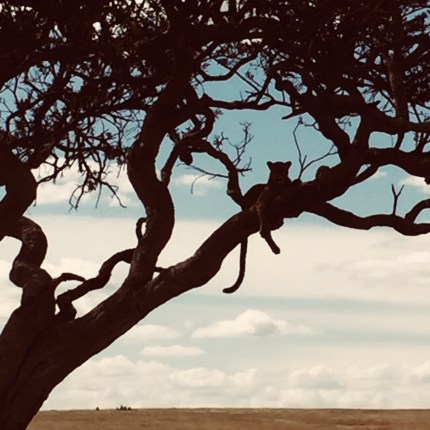
My eyes turn to match Harrison’s line of sight, and out there, off in the distance, I see a lone acacia tree. On one of its branches, there appears to be a cat-like creature with its legs and tail dangling below the branch. Acacia trees are one of the most beautiful accents that are peppered across the vast savannah horizon. They generally stand alone, so a baby blue sky and clouds provide a stunning backdrop for these simple-looking trees. The tree itself is unique, in that, a series of thick, leaveless branches fan out from the trunk and lead to bunches of leaves at the ends. The bare trunk and lower branches highlight the green foliage and the sky behind the tree.
“Oh, yeah, I do see it!”, I say mostly to myself as we continue to drive towards the tree. I had never seen a wild leopard before. They are typically most active at night, they live alone, and they only interact with other leopards while mating. They are often found up in trees, as they kill their prey and then drag it up the tree to eat it. They prefer hunting horned mammals (one of the many antelope species, for example), so they can use the horns to secure the carcass on one of the branches in the tree.
As we approach the leopard, it’s clear that it does not have a kill in the tree with it, so Harrison informs us that it’s resting, escaping from the hot savannah heat for a few hours. The mid afternoon sun was high in the sky at our equatorial location. We had spent most of the day shaded in our safari van, except for a picnic lunch under the shade of an acacia tree, looking out at a handful of elephants, giraffes, and a prowling lion in the distance. It seems like many of the animals seek shade and rest during this time of day, and the leopard was no exception.
We’re the first car to spot the leopard and arrive at the scene. Each van is equipped with a CB radio, which is used to keep in touch in the vast savannah. While we’re busily taking photos and ogling at our new discovery, Harrison picks up his radio and quickly informs his cohorts of the latest find: “niko na ya juu hapa kwa laga ya lowan hill”. In what could be a competitive environment, the safari guides all form a cooperative and friendly group. They freely share information, they often stop and greet each other when driving through the park, and for multi-day trips, they share lodging and dine together. There’s consistent Swahili chatter on the radio waves, informing the rest of the drivers of the latest sightings, and Harrison earns some good karma points by telling the rest of the guides where to see the leopard — the first leopard sighting of the day.
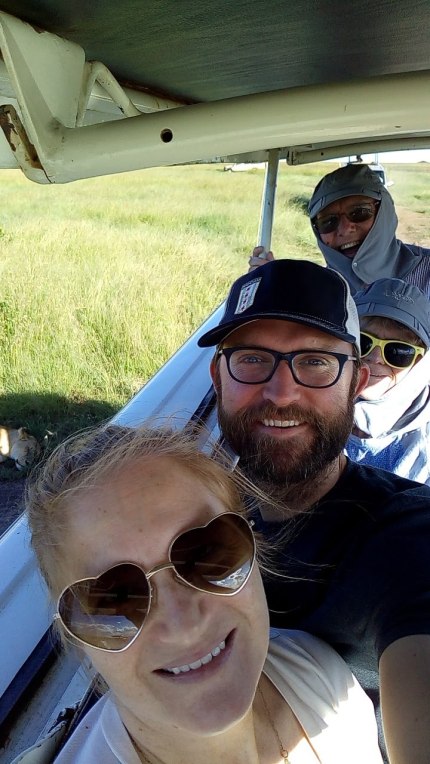
It takes several minutes for the vans to arrive. The roof of our van pops up, so we can all stand up and stick our heads through the top. We stare at the leopard as it ocassionally changes positions, giving us different views of its head and face. As the other vans arrive, they give a greeting and a nod to Harrison as they position their vehicles to get the best views of the leopard. Harrison seems to be a veteran among the driving crew. I’m guessing he’s in his mid 40s but looks like he could be younger. He’s been a tour guide for 15 years, and before that, he drove semi trucks across Kenya. He’s the youngest of 7, and his mother is alive and well at 98, living outside Nairobi in the Mount Kenya region. Harrison has a light-hearted but matter-of-fact demeanor. He’s incredibly well-informed, and most of the facts in this entry came from him.
The van party starts to feel a little crowded as more and more vans arrive, reaching up to about 10 or 12 before we decide to give up our prime viewing spot and move on to something else. Harrison puts the car into gear, and we pull away from the crowd, coming down from the excitement. We drive out into the wide open savannah, looking forward to seeing what’s next.
 Krisztina Finn
Exciting story, and well presented too. Super cool photos including the one with the four of you. ❤️
LikeLike
Beautiful post. Cannot wait to go on safaris myself.
LikeLike
The leopard was the only animal I didn’t get to see when I went on a safari 😦
LikeLike
Én nem szafarira megyek, hanem aludni. Jóéjt !
LikeLike
Ma reggel – viszonylag frissen – ismét végigolvastam. Nagyon tetszett, pedig csak egyetlen állatról írtál.
LikeLike